

Box Styles
Here is a high level summary, with pictures of different box styles that you will see at Berkley!
These box styles apply to both paperboard and corrugated!


01
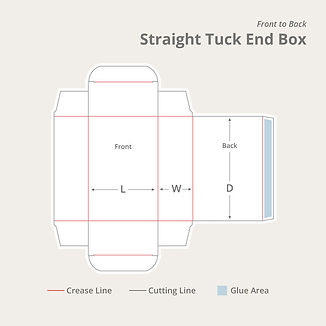
STRAIGHT TUCK-END CARTON (STE)
STE Cartons have the benefit of having
four clean folded edges on the face panel,
so that there are no raw edges.
The top and bottom lids both tuck to the
back, creating a clean brand presentation
for your product on the front of the box.
ADVANTAGES
-
Has four finished (uncut) edges on front for
-
better appearance than RTE’s
-
Can window to within 5/8” of front panel scores.
-
Glues same as RTE’s on straight-line gluer
-
Ships flat to customer.

02
REVERSE TUCK-END CARTON (RTE)
RTE Cartons cartons are generally more
economical than the STE, since it nests
well on the sheet.
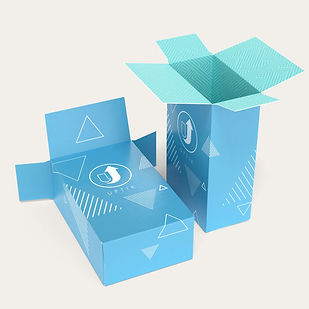
This style features a top closure that tucks
from the rear to the front, while the
bottom closure tucks from the front to
the rear of the box.
ADVANTAGES
-
Economical
-
Nests on press for maximum use of stock
-
Glues fast on the straight-line gluer; ships flat to customer.


03
TUCK-TOP SNAP-LOCK BOTTOM CARTON
(TTSLB)

TTSLB Cartons cartons (also known
as 1-2-3 Bottom cartons) feature four
flaps that fold and lock to form the
bottom.
This style is more cost-effective than
the Tuck Top Auto Bottom but may
require more time to assemble.
ADVANTAGES
-
Stronger bottom than STE’s or RTE’s, using slightly less stock.
-
Bottom will usually sit flatter on shelf.
-
Same straight-line gluing speed as STE’s and RTE’s
-
Ships flat to customer.
04
TUCK-TOP AUTO BOTTOM CARTON
(TTAB)
TTAB Cartons cartons (also known as Hymes Lock
cartons) have the advantage of a stronger base
than a STE, RTE, or a snap-lock bottom since the
bottom panels are glued in place.
It also makes for faster assembly/fulfillments times.
ADVANTAGES
-
Stronger bottom than tucks or snap-locks
-
Sets up fast in manual loading
-
Ships flat to customer


05
FULL OVERLAP SEAL-END (FOSE)
FOSE Cartons cartons are generally
assembled, filled and sealed on
automatic packaging equipment lines.
If hand assembly and fulfillment is
being utilized, peel-off glue strips can
be applied for manual sealing.
ADVANTAGES
-
Ideal for Single-Use applications.
-
Same straight-line gluing speed as STE’s and RTE’s
-
Ships flat to customer.


06
ROLL-SIDE TRAY (RST)
RST’s don’t require gluing and can also be used as lid tops with
the use outer tape or shrink-wrapping to keep both ends sealed.
ADVANTAGES
-
Ideal for Single-Use applications.
-
No Gluing
-
Ships flat to customer


07
REGULAR SLOTTED CONTAINER (RSC)
An RSC is the most common type of box. This is synonymous with a box. Think - Amazon shipping boxes - those are RSCs
ADVANTAGES
-
No Cutting dies
-
Easy to assemble and tape
-
Economical


08
ROLL-END TUCK TOP (RETT)
RETT’s don’t require gluing and provide a sturdy all-in-one option. These are usually assembled by hand. This style of box is synonymous with your higher end e-commerce shipping box.
ADVANTAGES
-
No Gluing
-
Sturdy Construction
-
Ships flat to customer


09
Half Slotted Container (HSC)

This is the same as the Regular Slotted Container (RSC) except that one set of flaps is excluded. Often used as a lid for a tray or a display.
ADVANTAGES
-
Extremely fast to manufacture on high-speed machines.
-
This significantly reduces production costs and allows you to have product delivered in the fastest possible time frames.
-
works as a lid for PDQ and other style trays/boxes
-
Ships flat to customer.

10
PDQ Tray (pretty darn quick)
PDQ Trays are a very common merchandising vehicle in the packaging world. They can be produced in paperboard, corrugated and even metal, plastic and other permanent solutions. They often sit on a shelf, counter top of check out lane.
ADVANTAGES
-
Preloaded product for good display on shelf
-
No labor needed to merchandise at a store level - comes pre loaded
-
No Gluing
-
Sturdy Construction
-
Ships flat to customer

